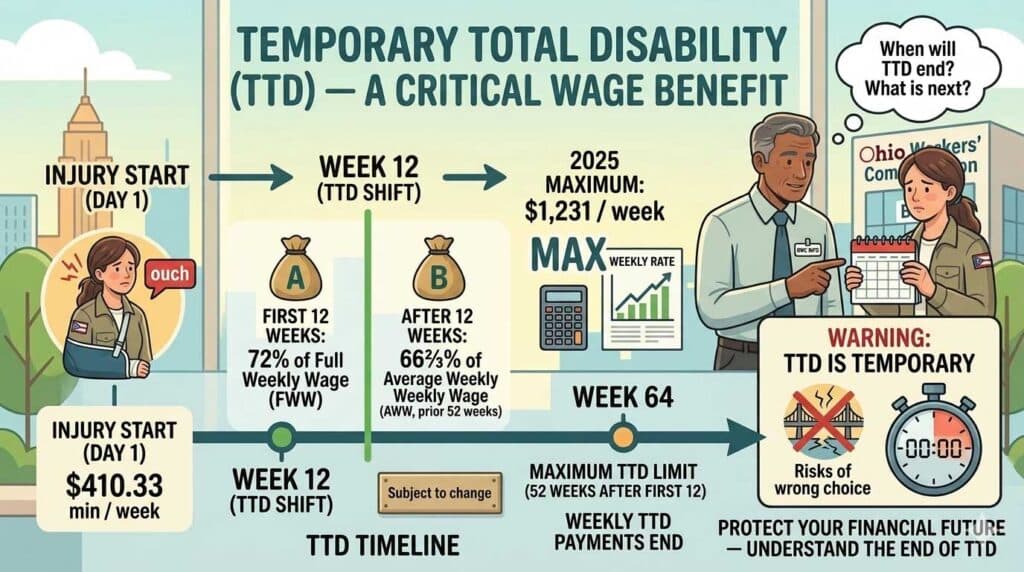
Ohio workers who are injured on the job and temporarily unable to work are generally entitled to Temporary Total Disability (TTD) — a wage-replacement benefit paid through the Ohio Bureau of Workers’ Compensation (BWC). TTD pays 72% of your full weekly wage (FWW) for the first 12 weeks, then shifts to 66⅔% of your average weekly wage (AWW) for the 52 weeks prior to your injury. For 2025, the maximum TTD rate is $1,231 per week (without Social Security retirement benefits), with a minimum of $410.33 per week.
But as its name makes clear, TTD is temporary. It will not last forever — and understanding when and why it ends is critical to protecting your financial future.
What Is Maximum Medical Improvement (MMI) — and Why Does It Matter?
TTD benefits end when you reach Maximum Medical Improvement (MMI). MMI is the point at which your medical condition has stabilized — meaning further treatment is not expected to produce meaningful functional improvement. It does not mean you are fully healed or that your treatment must stop. It simply means your condition is no longer considered “temporary” under Ohio law, and TTD payments must end.
Under Ohio law, your treating physician typically makes the MMI determination. However, the BWC or a self-insured employer can obtain an independent medical opinion to argue that you have reached MMI — and under the 2024 Ohio Supreme Court ruling in State ex rel. Dillon v. Indus. Comm. (2024-Ohio-744), employers and the BWC now have a faster mechanism to terminate TTD after an MMI finding. Critically, that ruling also allows the BWC or a self-insured employer to seek reimbursement from the injured worker for any TTD overpayments made after the MMI date — even if those payments were made while the case was still on appeal. This is a significant change from prior Ohio law and makes it more important than ever to have experienced legal representation monitoring your claim.
Can TTD Be Extended? Adding New or Changed Conditions
An MMI finding does not always have to be the end of TTD. One important strategy is adding new or changed conditions to your claim. Under Ohio law, when a new diagnostic condition develops — or an existing condition worsens — as a result of your original work injury, you may have a “new and changed condition” that restarts TTD eligibility for that condition.
A common example: an injured worker reaches MMI on a lumbar sprain, but later develops nerve damage or a new herniation at an adjacent spinal level as a result of the original injury – or an injured worker with a knee injury who’s walking with a limp (antalgic gait) causes flow through injury to the hip, other knee, or back, etc. – if that new condition is properly documented and subsequently allowed in the BWC claim, TTD may be reinstated while you treat/recover from the new condition.
This is not automatic — it requires proper medical documentation, ICD-10 compliant diagnoses, and timely legal action. An experienced attorney knows how to identify these opportunities and pursue them before the window closes.
What to Do If You’re Facing MMI
If your doctor — or the BWC — is signaling that MMI is approaching, do not wait. The steps you take in the weeks before and after an MMI determination can have a lasting impact on your claim. Here is what matters most:
- Contact your attorney immediately. Under the Dillon decision, delays can now result in overpayment demands. Your attorney needs to know your current medical status in real time.
- Discuss all of your symptoms. Make sure your treating physician is aware of every condition, pain point, and functional limitation — not just the primary injury. Undocumented conditions cannot be added to your claim later if they are not in the medical record now.
- Ask about flow-through conditions. Injuries often cause secondary problems — a knee injury leads to a hip problem; a shoulder injury leads to a cervical condition. These “flow-through” or consequential conditions may be allowable in your claim and can extend your eligibility for TTD and medical treatment.
- Do not assume MMI is final. An MMI finding can be challenged. If your treating physician disagrees with an independent medical examiner’s opinion, your attorney can file to contest the finding and request a hearing before the Ohio Industrial Commission.
Communication Is Everything
One of the most preventable mistakes injured workers make is failing to keep their attorney informed about changes in their medical condition. Ohio Workers’ Compensation claims are not static — they evolve, and so do the legal strategies needed to protect them. Keeping an open line of communication with your attorney is not just helpful; it is essential. If you’ve moved, change a phone number, changed your email address – make sure you notify your attorney about the changes.
If you have not already done so, make sure you are represented by an Ohio Board Certified Workers’ Compensation Specialist Attorney. Board certification in workers’ compensation is the highest level of recognition available to an Ohio attorney in this field — and it makes a real difference in the outcome of complex claims involving MMI, new conditions, and benefit termination disputes.
Talk to Mike Gruhin — Free Consultation
Mike Gruhin — OSBA Board Certified Specialist in Ohio Workers’ Compensation for over 30 years (1999–2030) — has represented thousands of Ohio injury victims at every stage of the workers’ compensation process, including MMI disputes and new and changed condition applications.
Don’t face MMI alone. Contact Mike Gruhin for Your Free, No-Obligation Consultation
Find out what our clients are saying — review our client testimonials.
Read Mike’s free guide: The Officially Unofficial Injured Worker’s Guide to Ohio Workers’ Compensation — no cost, no obligation.
Ready to fight back? You don’t have to figure this out alone.
Contact Mike Gruhin for Your Free Consultation
The consultation is free, the information is free, and the conversation could change your life.
If you or someone you know has been injured at work and is struggling to move forward, you may have more legal options than you realize.
📞 216-861-5555
🌐 https://www.gruhin.com
📋 https://www.gruhin.com/contact
⚖️ Mike Gruhin — OSBA Board Certified Ohio Workers’ Compensation Specialist Attorney
(Certified 1999–2030).
Board Certification means exceptional competence, experience, and professionalism in workers’ comp law — recognized by the Ohio State Bar Association.
Mike Gruhin and Gruhin & Gruhin, LLC — Fighting for injured workers across Ohio.
DISCLAIMER: By accessing any website page or website post, the reader agrees that (1) The information above is general in nature and is not legal advice; (2) No attorney-client relationship is created; (3) Each claim is unique and must be carefully evaluated on its specific facts under current Ohio law and the most recent court decisions; and, (4) Such evaluations require advice from an experienced Ohio Workers’ Compensation Attorney.