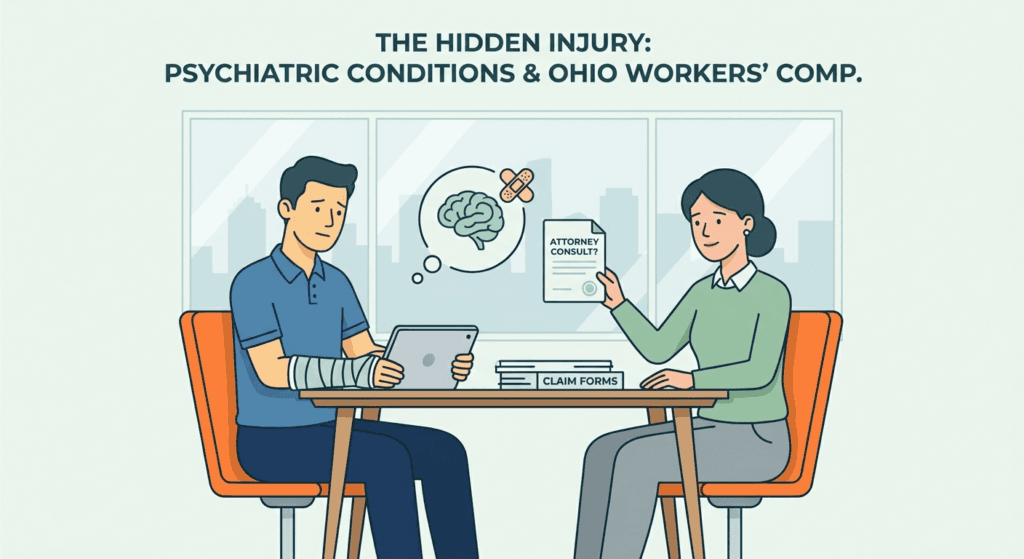
The Hidden Injury: Psychiatric and Psychological Conditions in Your Ohio Workers’ Compensation Claim
Most people don’t think about the emotional consequences of a workplace injury — but they should. Under Ohio law, depression, anxiety, PTSD, and other psychiatric conditions can be added to your workers’ compensation claim. Failing to pursue them can cost you significant benefits — sometimes for life.
What Ohio Law Says: The Physical-Mental Rule
Ohio Revised Code §4123.01(C)(1) defines “injury” for workers’ compensation purposes and specifically addresses psychiatric conditions. Under Ohio law, a psychiatric condition standing alone is not a compensable injury. However, it is compensable when it has “arisen from an injury or occupational disease sustained by that claimant.”
This is what practitioners call a “physical-mental” or “flow-through” claim: a psychological condition that flows directly from an allowed physical injury in your claim. The Ohio Supreme Court has confirmed that a direct causal link between the physical injury and the psychiatric condition is required — it is not enough that both arose from the same workplace accident if the psychiatric condition did not arise from the physical harm itself.
The bottom line: if you were physically injured on the job and that physical injury has caused or substantially contributed to a psychiatric condition, Ohio law allows that condition to be added to your claim.
Important distinction: Ohio does not recognize so-called “mental-mental” claims — psychiatric conditions arising solely from job-related stress, without any physical injury. The physical injury is the legal gateway.
What Conditions Can Be Added?
Psychiatric conditions that commonly flow from serious work injuries include, but are not limited to:
- Major depressive disorder (situational or clinical depression)
- Generalized anxiety disorder
- Post-traumatic stress disorder (PTSD)
- Adjustment disorder with depressed or anxious mood
- Chronic pain disorder with associated psychological features
These are real, diagnosable medical conditions — not weakness, not exaggeration. They can limit your ability to work just as surely as a broken bone or a herniated disc.
Warning Signs You May Have a Compensable Psychiatric Condition
You should seriously consider whether a psychiatric condition should be part of your claim if any of the following apply:
- Your injury has kept you off work for six months or more
- You have suffered a severe or permanently disabling injury
- You have given up hobbies or activities you once enjoyed
- You have become withdrawn, isolated, or reclusive
- You experience persistent irritability, hopelessness, or loss of motivation
- You have difficulty sleeping or suffer nightmares related to your injury
- You relive the accident through flashbacks or intrusive thoughts
- You feel anxious or fearful about medical treatment, returning to work, or your financial future
- Family members or close friends have noticed a dramatic change in your personality or mood
None of these symptoms should be dismissed as “just part of dealing with an injury.” They may represent a separately compensable condition that entitles you to additional medical treatment and, in some cases, additional disability compensation.
How a Psychiatric Condition Is Added to Your Claim
Under BWC policy, the injured worker — not the treating physician — must be the one to request allowance of a psychiatric or psychological condition. Your attorney does this by filing a C-86 Motion with the Bureau of Workers’ Compensation (BWC) or the Industrial Commission (IC).
The C-86 form for a psychiatric condition requires a signed written acknowledgment by the injured worker stating that they are aware the motion is requesting the claim be additionally recognized for a psychiatric or psychological condition that is a result of the injury for which the claim is already allowed.
Supporting documentation typically includes:
- A diagnosis from a licensed psychiatrist or psychologist
- A narrative medical report establishing the causal connection between the allowed physical conditions and the psychiatric diagnosis
- Treatment records documenting the onset, progression, and treatment of the condition
Note for treating physicians: Physicians and MCOs cannot initiate a psychiatric allowance on a C-9 form. The C-86 Motion filed by the injured worker or their attorney is the required mechanism for psychiatric/psychological condition allowances.
The BWC and the employer’s managed care organization (MCO) will scrutinize these claims carefully. Employers and MCOs routinely arrange for independent medical examinations (IMEs) with physicians who may dispute the diagnosis or the causal connection. Having an experienced workers’ compensation attorney is not optional — it is essential.
A Note on First Responders
Ohio law provides a limited exception for first responders. Under House Bill 308 (effective 2021), qualifying first responders — firefighters, police officers, and EMTs — may be eligible for PTSD-related workers’ compensation benefits even without a corresponding physical injury, through a separate fund administered by the Ohio BWC. This is a narrow carve-out from the general physical-mental rule, but an important one for those in high-risk public safety roles.
Why Many Attorneys Miss This
Surprisingly, many Ohio workers’ compensation attorneys are not attuned to psychiatric flow-through claims. Some focus exclusively on the physical injury and never probe whether their client is suffering emotionally. Others lack experience with psychiatric causation opinions, IME defense, or IC hearing strategy on psychological conditions.
If you have discussed your emotional symptoms with your attorney and received no response — no referral to a mental health professional, no discussion of adding a psychiatric condition to your claim — that is a serious red flag. You may need a second opinion.
The Real Cost of Missing a Psychiatric Claim
If a psychiatric condition is successfully added to your claim, you may be entitled to a full range of additional benefits.
Authorized Medical Treatment
Once allowed, your psychiatric condition entitles you to authorized treatment — therapy, psychiatry, and medication management — through the BWC system.
Temporary Total Disability (TTD) Compensation
If the psychiatric condition, standing alone or in combination with your physical restrictions, prevents you from returning to work, you may be entitled to TTD compensation during periods of psychiatric disability.
Permanent Partial Disability (PPD)
Ohio law allows PPD impairment compensation for permanent psychiatric impairment. The BWC itself states that PPD eligibility extends to workers who suffer “a loss-of-use injury or psychiatric condition because of the work-related injury.” Impairment is rated under the AMA Guides, and a percentage award translates into a lump-sum or periodic payment.
Permanent Total Disability (PTD) — A Critical Benefit
This is where having an allowed psychiatric condition can make the single biggest difference in your case.
Under Ohio Administrative Code Rule 4121-3-34(D)(3)(i), when a psychiatric condition has been allowed in a claim and the injured worker retains some physical ability to work, the Industrial Commission hearing officer must consider whether the allowed psychiatric condition — in combination with the allowed physical conditions — prevents the injured worker from engaging in sustained remunerative employment.
This is enormously important. Many injured workers can be shown to have some residual physical capacity for light or sedentary work. Without an allowed psychiatric condition, the employer can argue that residual physical capacity defeats PTD. But when an allowed psychiatric condition is also in the picture, the hearing officer must evaluate the combined effect of both the physical and psychiatric impairments before reaching a conclusion on PTD.
The Ohio Supreme Court confirmed this framework in State ex rel. Urban v. Wano Expiditing, Inc., 2025-Ohio-3009, where a claim allowed for both physical and psychological conditions (including depressive disorder and anxiety disorder) required the Industrial Commission to evaluate all allowed conditions — physical and psychiatric together — in adjudicating a PTD application.
In practical terms: a worker who might be denied PTD based on physical conditions alone may qualify for PTD when an allowed psychiatric condition is factored in. This is a lifetime benefit. The stakes could not be higher.
Summary: Every Allowed Condition Matters
| Benefit | Impact of Allowed Psychiatric Condition |
|---|---|
| Medical treatment | Authorized therapy, psychiatry, medications |
| TTD compensation | Payable if psychiatric condition causes disability |
| PPD award | Rated psychiatric impairment compensated separately |
| PTD (lifetime) | IC must consider psychiatric + physical conditions together under OAC 4121-3-34(D)(3)(i) |
Call Gruhin & Gruhin
At Gruhin & Gruhin, we have successfully obtained allowance of emotional overlay and psychiatric conditions for our Ohio workers’ compensation clients. We understand the medical evidence required, the C-86 process, how to defend against employer IMEs, and — critically — how an allowed psychiatric condition can be the key to a successful PTD application.
We fight to make sure every condition — physical and psychological — is properly recognized in your claim, because every allowed condition matters to your future benefits.
If you don’t have an attorney, call us. If you have an attorney but have never had a conversation about whether a psychiatric condition belongs in your claim, make sure to discuss it with him/her.
Initial consultations with Mike Gruhin, OSBA Board Certified Ohio Workers’ Compensation Specialist Lawyer, are always free with no obligation to retain our firm.
http://www.gruhin.com/contact
📞 216-861-5555 🌐 gruhin.com
Gruhin & Gruhin — 24100 Chagrin Blvd., Suite 120, Beachwood, Ohio 44122
Gruhin & Gruhin fights for you.