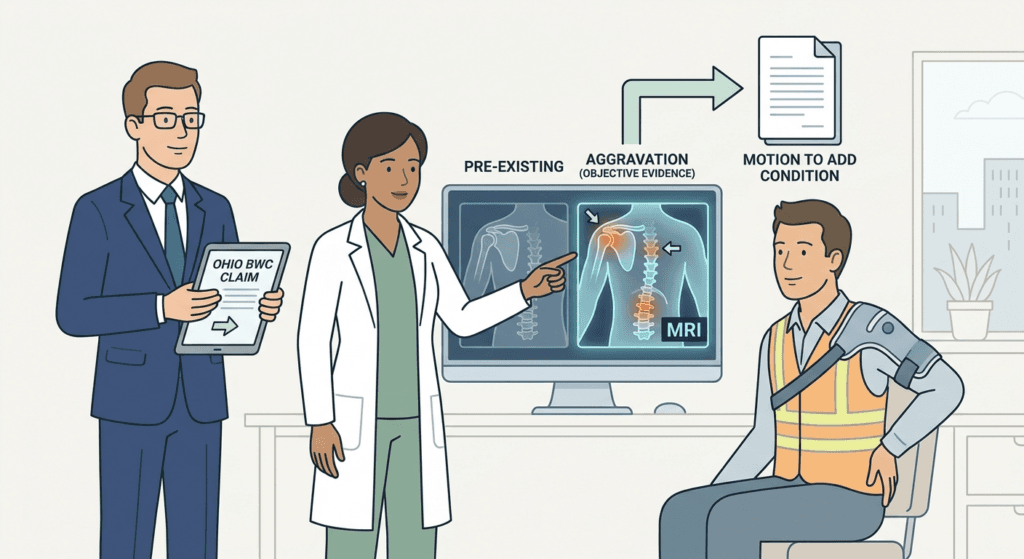
How to Win an Ohio Workers’ Comp Substantial Aggravation of a Pre-Existing Condition Claim
Getting Paid for Old Injuries: The 2026 Guide to Ohio Substantial Aggravation
Think Your Old Injury Blocks Your New Claim? Think Again.
Here is one of the most common things injured workers say when they call our office: “I have an old back injury, so I probably can’t get workers’ comp, right?” Or: “I have arthritis — my employer is going to say that’s why I can’t work, not the accident.”
This is a myth. Under Ohio law, you can receive full workers’ compensation benefits if your work injury “substantially aggravated” a condition you already had — even arthritis, even a prior surgery, even degenerative disc disease. Here is exactly how the process works in 2026.
Q: I Have Arthritis — Can I Still Get Workers’ Comp if the Job Made It Worse?
A: Yes — and this is the most important thing to understand about pre-existing condition claims.
Medical science recognizes that degenerative changes in joints, discs, and soft tissue can begin in early adulthood. In fact, former high school and college athletes may already have degenerative changes from sports injuries sustained years before they ever set foot in the workplace. This means virtually any adult worker, regardless of age, may have a pre-existing degenerative condition — whether they know it or not.
The law does not require you to be in perfect health before a work injury. What matters is whether your work accident substantially aggravated the condition you already had — meaning it made things measurably worse, beyond the “natural aging progression” of the underlying disease.
Consider this real-world example: You have arthritis in your knee. For years, you have worked full shifts, climbed stairs, lifted parts, and done your job without restriction. Then a workplace accident occurs. Afterward, your knee range of motion is physically blocked, you cannot bear weight without pain, and you eventually need surgery. That is a textbook substantial aggravation — the arthritis existed before, but the work injury pushed you past the threshold you had maintained for years.
The law covers that. Don’t rule it out yourself. Let a workers’ compensation attorney and your physician of record evaluate whether you have a claim worth pursuing. As we say in this practice: “The squeeze is worth the juice.”
Q: What Proof Do I Need? What Does the Law Actually Require?
A: The governing statute is R.C. 4123.01(C)(5). Under that provision, a pre-existing condition is covered by workers’ compensation only if the aggravation is documented by objective diagnostic findings, objective clinical findings, or objective test results.
In plain English, that means one or more of the following must be present:
- Objective diagnostic findings — imaging studies such as an MRI, X-ray, or CT scan showing a measurable change.
- Objective clinical findings — physical examination results your doctor or therapist records, such as decreased range of motion, muscle spasm, positive orthopedic test results (like a positive Hawkins Test or Neer’s Test for the shoulder), or observable swelling.
- Objective test results — nerve conduction studies, electromyography (EMG), functional capacity evaluations, or similar quantifiable measurements.
An important point that many lawyers overlook: the statute is written in the disjunctive — “OR.” You do not need all three. One category of objective evidence, supported by your physician’s expert opinion, can be enough to pursue the claim. Subjective complaints — your reports of increased pain — can serve as supporting evidence, but they cannot stand alone without at least one form of objective documentation backing them up.
In 2026, BWC requires more than an injured worker’s report that they are in more pain. They require measurable, documented physical change. The consistency and quality of your medical records from the very first visit after the work injury will make or break your case.
Q: What Should I Tell My Doctor and Physical Therapist?
A: Your medical team’s notes are what the BWC scrutinizes. Every visit matters. You need to communicate clearly how your functional baseline has changed. It is not enough to say “it hurts more.” You need to explain — and your provider needs to record — the specific, measurable ways your body no longer performs the way it did before the accident.
Examples of useful functional history to communicate:
- “Before this accident, I was working full 10-hour shifts without restriction. Now I cannot stand for more than 20 minutes without my knee giving out.”
- “Before the accident, I could lift 50 pounds as part of my regular duties. Now my range of motion in my shoulder is blocked at 90 degrees.”
- “I had some back problems before, but they were managed. I worked full time for 15 years. Since the accident, I cannot sit for more than 15 minutes.”
When your provider conducts positive orthopedic tests, records measurable loss of range of motion, notes observable muscle spasm, or orders imaging that shows structural change — that is the objective clinical evidence the statute requires. Ask your physician to document both the findings and their opinion that those findings are causally related to the work injury.
Q: What If I Don’t Have Medical Records From Before My Work Accident?
A: You may not need them — but you need to understand the current state of Ohio law on this point, because it is not yet uniform across the state.
For years, employers and their counsel argued that an injured worker needed a “before and after” MRI to prove a worsening — a documented baseline from before the accident, then a post-injury study showing measurable change. That was used as a weapon to defeat legitimate claims where workers simply had not needed imaging before the accident because their condition, while present, had never caused significant limitation.
In Taye v. Cuyahoga Hills Juvenile Corr. Facility, 2026-Ohio-39, the Eighth District Court of Appeals reversed summary judgment for the employer and held that a separate pre-injury medical baseline is not required under R.C. 4123.01(C)(5). Here is what made the difference in that case:
- The treating chiropractor, Dr. Nichols, examined the injured worker six days after the April 2021 incident and performed objective orthopedic tests — the Apley Scratch Test, Neer’s Test, and Hawkins Test — all of which were positive.
- A post-injury MRI showed structural issues like AC joint arthrosis and edema.
- Critically, Dr. Nichols provided expert opinion testimony that the degenerative changes visible on the MRI were chronic in character and by their nature predated the work injury.
The court held that this created a genuine issue of material fact sufficient to survive summary judgment. The key lesson from Taye: What you need is a physician willing and able to review your post-injury objective findings and render a professional opinion that the findings reflect pre-existing degenerative changes that were substantially aggravated by the work incident. The right doctor can substitute for the absence of pre-injury records.
An important caveat: Taye is an Eighth District (Cuyahoga County area) decision. The First District Court of Appeals has taken a stricter view in prior cases. Experienced legal counsel is essential to navigating which approach applies to your claim.
Q: Can the BWC Stop My Benefits if My Condition “Resets” to My Pre-Injury State?
A: Yes. Under R.C. 4123.54(G), the BWC may stop compensation and medical treatment if they determine the substantial aggravation has subsided. This makes consistent, objective documentation from your medical providers vital throughout the life of your claim.
There is also a compelling legal counterargument: if you have already received a permanent partial disability (PPD) award based on the substantially aggravated condition, how can that condition be said to have “returned to baseline”? A PPD award reflects a permanent, measurable impairment. This argument is worth raising with your attorney before the BWC closes the condition.
Q: Will the BWC Send Me to an Independent Medical Exam?
A: Yes. When a motion to add a substantially aggravated pre-existing condition is filed, BWC policy permits an independent medical examination (IME). These exams are often scheduled by the other side to contain costs, meaning they may not truly be independent.
This is why the quality of your treating physician’s records matter from day one. A well-documented claim with a clear physician’s expert opinion tends to move through the process at the Industrial Commission more cleanly. Your attorney can help you prepare and can challenge an adverse medical opinion through the hearing process.
Navigating the substantial aggravation standard requires an experienced lawyer. An OSBA Board Certified Ohio Workers’ Compensation Specialist Lawyer stays current on the latest appellate rulings and BWC policy. The right legal representation can mean the difference between a denied claim and full benefits. Don’t let a pre-existing condition be the reason you walk away from a claim you are entitled to bring.
Need Help Navigating the Process?
If you need legal representation for your Ohio Workers’ Compensation Claim, contact Mike Gruhin for your Free, No-Obligation Consultation.
Officially Unofficial Guide to Ohio Workers’ Compensation
Understand how an Ohio Workers’ Compensation claim works.
By Appointment Only
24100 Chagrin Blvd. Suite 120, Beachwood, Ohio 44122
This article provides general information and should not be considered legal advice. This article does not create any attorney-client relationship between the author and the reader.