Lockout/tagout failures and warehouse machinery injuries in Ohio
When machinery starts moving without warning, the consequences can be permanent. Ohio injured workers have more legal options than many realize.
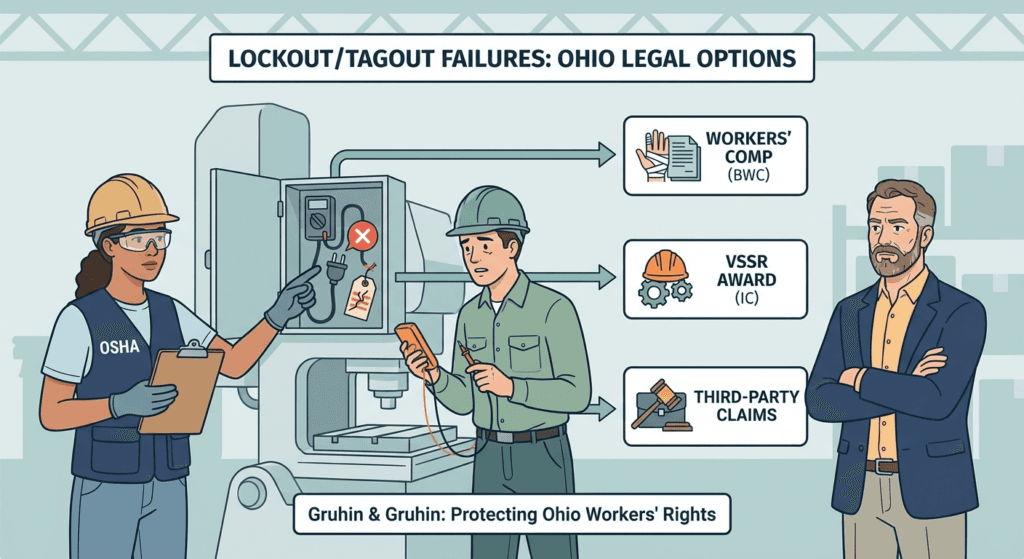
● VSSR award (IC)
● Intentional tort
● Third-party claims
The worker clearing a jammed conveyor, troubleshooting a sensor, or performing a quick repair has every reason to believe the machine is safe. When it is not, the question is not just what machine caused the harm — it is what allowed hazardous energy to remain uncontrolled before that worker was put in harm’s way.
Mike Gruhin has represented injured Ohio workers for nearly 50 years. When a warehouse machinery injury involves a lockout/tagout failure, we look at the full picture.
What is lockout/tagout — and why does it matter?
Lockout/tagout (LOTO) is the process for shutting down machinery, isolating its energy sources, and preventing unexpected startup or release of stored energy while workers service or maintain equipment. It is required under two overlapping but legally distinct frameworks.
The federal level (OSHA): Standard 29 CFR 1910.147 requires employers to use specific energy control procedures so that a machine cannot move, cycle, compress, rotate, or re-energize while a worker is in the danger zone. OSHA explicitly identifies lockout/tagout failures as a top hazard in the warehousing industry.
The state level (Ohio Industrial Commission): The IC enforces its own independent safety requirements under OAC 4123:1-5, which address machine guarding, point-of-operation protection, and energy control. These Ohio-specific rules are the legal foundation for a VSSR claim when an employer’s lockout/tagout failure injures a worker.
OSHA governs regulatory compliance and informs third-party civil liability. OAC 4123:1-5 controls whether an injured worker is entitled to an additional VSSR award through the Industrial Commission. These are separate legal frameworks serving different purposes.
Hazardous energy is not limited to electricity. Mechanical tension, hydraulic pressure, pneumatic pressure, gravity, and thermal energy can all cause catastrophic injury after a machine appears to be off.
Warehouse machinery and the hazard of uncontrolled energy
Ohio warehouses run on fast-paced, heavily mechanized operations. Conveyor and sortation systems move product continuously. Palletizers and depalletizers cycle automatically. Compactors and balers compress material under enormous force. Shrink-wrap lines, dock equipment, powered gates, robotic systems, and mechanical lifts all share a common characteristic — they store and release energy in ways that are not always visible to the workers sent to service them.
The primary danger is that hazardous energy remains present long after a machine appears to have stopped. A worker reaches in to clear a jam, a coworker restarts the line, or an automatic cycle triggers. That is the moment a routine task becomes a life-altering injury. Ohio warehouses that rely heavily on temporary labor, staffing agencies, or multilingual workforces face heightened risk when training is rushed, inconsistent, or bypassed entirely.
How lockout/tagout failures happen
Most serious warehouse machinery injuries follow the same pattern: a worker clears a jam, the machine was never fully locked out, and it moves. Common failure points:
Ohio workers’ compensation: your first layer of protection
If you are hurt in a warehouse machinery accident in Ohio, you can file a workers’ compensation claim regardless of who was at fault. The Ohio BWC covers medical bills, pays a portion of lost wages while you recover, and provides compensation for permanent impairment. In the most serious cases — amputations, severe crush injuries, traumatic brain injuries — workers’ comp is only the starting point. Because Ohio statutory caps limit what an employer must pay under a standard claim, exploring every available avenue of accountability is essential.
Your legal options — three additional claims
⚖
An additional penalty award on top of BWC benefits when an employer violates Ohio’s specific safety rules under OAC 4123:1-5.
⚖
Steps outside workers’ comp entirely when an employer deliberately removed guarding or knowingly sent workers into a danger zone under R.C. 2745.01.
⚖
Targets manufacturers, contractors, staffing agencies, and system integrators whose negligence contributed to the injury.
by the Industrial Commission when a specific Ohio safety rule violation is proven under R.C. 4123.95.
VSSR claims: additional awards under Ohio safety rules
VSSR claims are strictly governed by Ohio’s own administrative framework — R.C. 4123.95 and OAC 4123:1-5. An OSHA citation arising from the same incident is not controlling in a VSSR proceeding and does not automatically establish a violation, though OSHA materials may provide relevant context. A VSSR application is filed with the Industrial Commission, not BWC, and proceeds through a separate hearing process. The burden is on the injured worker to identify the precise Ohio safety rule violated and establish that it directly caused the injury.
Ohio intentional tort: stepping outside the workers’ comp system
In egregious cases, an employer’s conduct may rise to the level of an intentional tort under R.C. 2745.01, allowing an injured worker to pursue full civil damages — including pain and suffering and loss of quality of life — directly against the employer. The threshold is high. Ohio courts have interpreted this statute narrowly since Houdek v. ThyssenKrupp Materials N.A., Inc. (2012).
Two fact patterns are most relevant in lockout/tagout cases. The first is physical — an employer that removed machine guarding, bypassed interlocks, or disabled safety devices with knowledge that injury was substantially certain. The second is procedural — an employer that knowingly maintained a deficient lockout/tagout procedure while continuing to send workers into the danger zone. Where management was aware the procedure was inadequate — through prior incidents, ignored OSHA citations, or internal communications — that documented knowledge can support the deliberate intent required by R.C. 2745.01.
Third-party claims: maximizing your financial recovery
While a VSSR addresses your direct employer’s violations of Ohio’s own safety rules, third-party civil claims target outside entities whose negligence contributed to your injury. Federal OSHA standards and any issued citations become major components of the case — used in civil court to establish the accepted standard of care. Third-party liability can extend to equipment manufacturers for defective designs, maintenance contractors who left machinery in a hazardous state, staffing agencies that failed to verify safety training, and system integrators responsible for a flawed automated line design.
Third-party claims are subject to Ohio’s subrogation statutes — R.C. 4123.93 and R.C. 4123.931 — and must be coordinated with your active BWC claim to address statutory liens. Subrogation is outside of the scope of this article but is covered elsewhere on our website.
Building the case: evidence
These cases depend on early evidence that can disappear quickly, such as:
The question is never just whether a safety program existed on paper. It is whether the worker in front of that machine was actually protected when it mattered.
Request an OSHA inspection — do it promptly
One of the most important steps after a serious warehouse machinery injury is requesting a formal OSHA inspection immediately. Evidence disappears fast — machines get repaired, guards reinstalled, software updated. An official inspection documents the unmodified scene and generates citation records that carry weight in civil proceedings and may be filed with a VSSR application.
Complaints can be filed anonymously. Federal law prohibits OSHA from disclosing a complainant’s identity to the employer. Provide as much detail as possible about the machine, its name, serial number, location, and the nature of the energy isolation failure.
By accessing and reading this article, the reader agrees that no attorney-client relationship is created. This article provides general information and does not constitute legal advice. For guidance specific to your situation, contact us directly. Laws in Ohio change frequently. This article is up to date as of May 29, 2026.