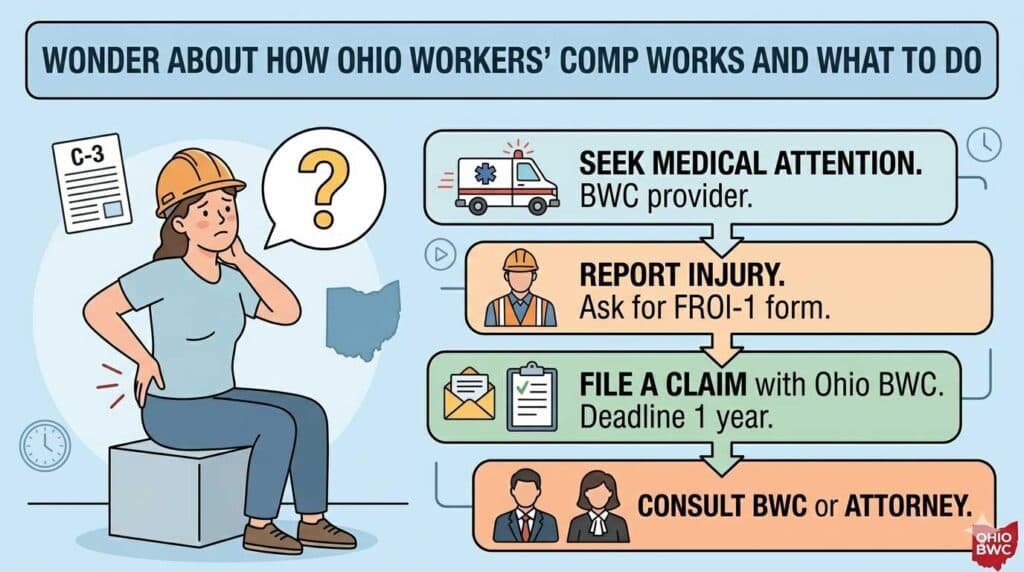
I hurt myself on the job today — now what do I do?
Filing an Ohio BWC Claim: A 2026 Step-by-Step Guide by OSBA Board Certified Ohio Workers’ Compensation Lawyer Specialist Mike Gruhin.
You didn’t plan for a workplace injury. Take a breath. You have strict legal rights under Ohio law, but your actions right now matter enormously.
● Report injury
● BWC FROI-1 filing
● TTD wage replacement
One moment you were doing your job—lifting, moving, driving, or sitting at your desk—and now you’re hurt. Maybe it’s your back. Maybe your knee gave out when you slipped on the stairs, or you were struck by faulty equipment. Whatever happened, you’re in pain, you’re stressed, and you have no idea what to do next.
This post walks you through exactly what to do, step by step, to secure the benefits, medical coverage, and wage replacements you are legally entitled to receive under the Ohio Bureau of Workers’ Compensation (BWC) system.
Step 1: Get medical attention — right now
Your health comes first. If your injury is severe, call 911 or have someone take you to the emergency room immediately. Do not try to “walk it off” or wait to see if it improves tomorrow. Many serious physical issues—such as herniated discs, internal fractures, torn ligaments, and concussions—do not fully manifest until hours after the immediate shock wears off.
When you see the treating doctor, tell them explicitly: “I was injured at work.” These words are essential. The emergency room or clinic’s initial treatment charts establish the medical foundation of your whole claim. Ensure the record accurately notes:
- The exact date, time, and shift of the incident.
- The precise physical mechanics of how you were hurt.
- Every single symptom or area of pain—even things that feel like minor aches right now.
Under Ohio BWC rules, you possess the absolute right to select your own treating physician. You are not required to stick with your employer’s preferred clinic or doctor. Choosing an independent, certified physician ensures an objective advocate has your back from day one.
Step 2: Report the injury to your employer — today
As soon as you are stable, report the injury to your employer. **Do this in writing.** An email, a text message, or a copy of an official company incident report creates an unalterable digital footprint. Do not rely solely on a verbal conversation with a supervisor, as undocumented conversations are frequently forgotten or contested later.
While Ohio law doesn’t enforce an immediate reporting deadline for the employer notification itself, waiting days or weeks gives insurance adjusters an excuse to claim that your injury occurred outside of work hours. Be detailed and accurate when filling out any forms: describe exactly what happened, where, and identify every hurt body part. Do not minimize your condition.
Step 3: File your claim with the Ohio BWC
Never assume your employer will file your workers’ compensation claim correctly, or file it at all. Ultimately, you are legally responsible for ensuring your claim enters the state system.
Need Help Navigating the Process?
If you need legal representation for your Ohio Workers’ Compensation Claim, contact Mike Gruhin for your Free, No-Obligation Consultation.
Under Ohio Revised Code § 4123.84, you have a strict one-year statutory deadline from the date of the injury to file your claim with the Ohio BWC. If you miss this window, your right to receive medical bills or wage payouts is gone permanently—no matter how debilitating your physical state is. The clock begins ticking the day you were hurt, not when you reported it or saw a doctor.
Your claim is initiated by completing a First Report of Injury (FROI-1) form. This can be submitted online via the BWC portal, completed by your independent treating doctor, or managed directly by an authorized workers’ comp specialist attorney. Once submitted, the BWC is required to issue an official allowance or denial within 28 days.
Step 4: Know what benefits you are entitled to
Because Ohio is a no-fault system, you do not need to prove your employer did anything wrong. You must simply establish that the injury occurred within the course and scope of your employment. If your claim is allowed, you can tap into multiple benefit types:
🩹
Covers authorized doctor visits, emergency surgeries, hospital stays, medical devices, physical therapy, and required prescriptions.
💵
Replaces income while you recover. First 12 weeks pay at 72% of full weekly pay, dropping to 66.67% thereafter.
🚗
Reimburses mileage for round-trip travel over 45 miles to authorized appointments at the 2026 rate of $0.725 per mile.
payouts for long-term physical impairment.
The Waiting-Week Rule: Under Ohio law, no wage replacement is paid for the first 7 days off work. If you are off 8 to 13 days, TTD begins on day 8. If you are disabled for 14 or more consecutive days, TTD payments are retroactively paid back to day 1.
Step 5: Build your paper trail from day one
Insurance companies, managed care organizations, and defense teams scan files for inconsistencies or delays to deny or reduce benefits. Build an ironclad record:
Free Compensation Manual
Download our comprehensive guide, the Officially Unofficial Guide to Ohio Workers’ Compensation, to maximize your recovery paths and avoid costly administrative pitfalls.
Avoid these six critical mistakes
In the stress and confusion immediately following a serious job accident, small procedural errors can completely sink a legitimate claim. Make sure to avoid these pitfalls:
What if you were hurt while working from home?
Remote and telecommuting arrangements are completely recognized forms of regular employment in Ohio. Injuries occurring in a home office are entirely compensable under BWC rules, provided the physical trauma occurred within the “course and scope” of your specific employment obligations.
If you were actively engaged in a job requirement—such as lifting business equipment, setting up an assigned workstation, or completing a work task—when you were hurt, you have a valid claim path. Document exactly what work duties you were executing at the exact second of injury and secure specialized legal review immediately, as remote-site cases require detailed handling.
What happens after you file?
Once your initial FROI-1 form is submitted, your employer’s designated Managed Care Organization (MCO) takes over medical management and processing. If the claim gets a formal denial within the 28-day statutory window, your appeal pushes the dispute to the Ohio Industrial Commission (IC)—the independent state hearing entity that conducts trials to resolve workers’ compensation conflicts.
The formal administrative appeals track is governed by strict, unyielding calendars, evidentiary motions, and live medical testimony. Missing a single hearing date or filling out a form with incorrect code classifications can terminate your access to benefits permanently. This administrative track is not a system built to be handled without experienced help.
Client Video Testimonials
Hear directly from the Ohio workers and families we have helped protect over the past 50 years. See how specialized legal representation makes a real difference.
By accessing and reading this article, the reader agrees that no attorney-client relationship is created. This article provides general information and should not be considered legal advice. Form links connect directly to official Ohio BWC assets. For guidance specific to your situation, contact us directly. Laws change frequently. This article is up to date as of May 29, 2026.