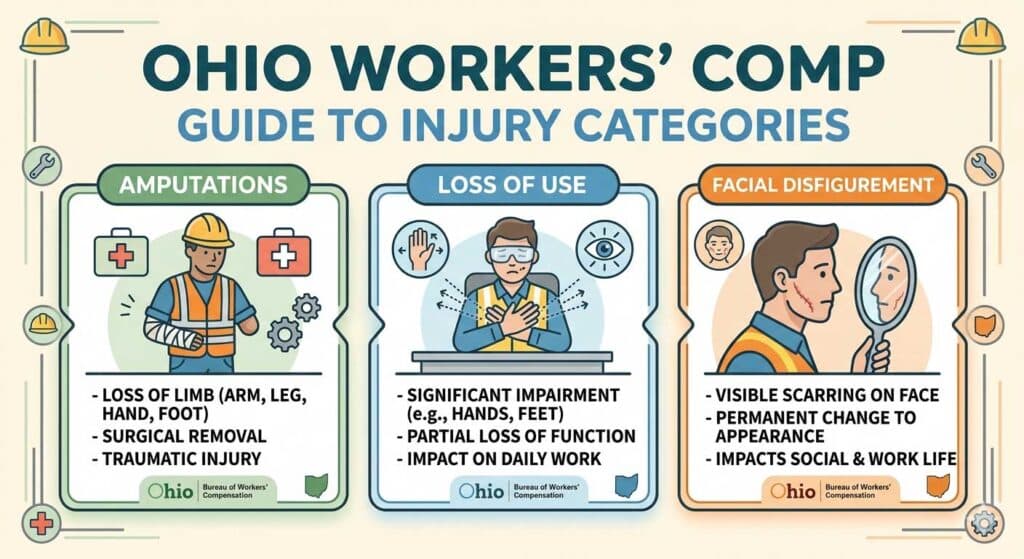
Ohio Workers’ Compensation: Amputations, Loss of Use, and Disfigurement
What Is at Stake
Losing a hand, a finger, your vision, or your hearing in a workplace accident is life-changing. Ohio law recognizes this with a category of benefits called scheduled loss awards — fixed compensation payments tied directly to the body part you lost. These awards are paid in addition to any temporary total disability benefits you already received, and they do not require you to prove ongoing wage loss. The money is yours by statute.
The problem is that the system will not automatically calculate the full value of your claim and hand it to you. Scheduled loss claims are heavily litigated. Employers and their insurers challenge injury dates, dispute whether a true “loss of use” occurred, and look for prior awards to offset against your recovery. An unrepresented injured worker almost always leaves money on the table.
Beyond the Basic Award: What Many Injured Workers Miss
A scheduled loss award is a starting point, not the ceiling of your recovery. Gruhin & Gruhin analyzes every amputation and loss-of-use claim for additional compensation that most injured workers — and frankly, many attorneys — overlook:
Violation of a Specific Safety Rule (VSSR): If your amputation was caused by your employer’s failure to comply with a specific Ohio safety regulation — inadequate machine guarding, for example — you may be entitled to a separate VSSR award on top of your scheduled loss award. VSSR claims carry their own procedural deadlines and must be aggressively pursued.
Intentional tort action against your employer: Ohio workers’ compensation is ordinarily the exclusive remedy against an employer for a work injury — meaning you cannot sue your employer in civil court simply because they were negligent.
However, Ohio law recognizes an important exception. Under R.C. 2745.01, if your employer deliberately intended to cause your injury, or if your employer removed or failed to install a safety guard or device knowing that injury was substantially certain to follow, you may have a civil intentional tort claim entirely outside the workers’ compensation system.
This is not a low bar — Ohio courts apply it strictly — but for amputation cases involving unguarded machinery, disabled safety interlocks, or equipment your employer knew was dangerous, it deserves serious evaluation. A successful intentional tort claim can recover damages that workers’ compensation never provides, which can include pain and suffering, full lost wages without statutory caps, and potentially punitive damages.
The intentional tort claim and the workers’ compensation claim can proceed simultaneously, and any workers’ compensation benefits paid may be subject to a subrogation lien — another reason to have experienced counsel coordinating both tracks from the start.
Third-party civil actions: When a work-related amputation is caused in whole or in part by someone other than your employer, Ohio law allows you to pursue a separate civil lawsuit against that third party entirely outside the workers’ compensation system — and without giving up your workers’ comp benefits.
Common third-party defendants in amputation cases include machine or equipment manufacturers (products liability — defective design, defective guarding, or failure to warn), contractors or subcontractors on multi-employer job sites, property owners who controlled the premises where you were injured, and drivers responsible for motor vehicle accidents during the course of employment. A third-party claim can recover the full range of tort damages: pain and suffering, disfigurement, loss of consortium, full past and future lost earnings, and all medical expenses — compensation that dwarfs what the workers’ compensation schedule provides for the same loss.
The trade-off is subrogation: under R.C. 4123.93 and 4123.931, BWC has a statutory right of recovery against your third-party proceeds for workers’ compensation benefits paid on your claim, and you have an affirmative obligation under R.C. 4123.931(G) to notify BWC of the third-party claim and any potential settlement.
Importantly, BWC’s share of the net recovery is not a dollar-for-dollar reimbursement — Ohio law uses a proportional formula that takes into account your total uncompensated damages, which means skilled negotiation and litigation of the lien can significantly reduce what BWC recovers. Settling the tort case without properly addressing the BWC lien can leave you personally liable to repay BWC out of your own pocket — one of the most costly and avoidable mistakes in this area of the law.
Depression and psychological overlay: Amputation injuries frequently give rise to clinical depression, PTSD, anxiety, and adjustment disorders. If a psychological condition develops as a direct result of your physical loss, it can be allowed as an additional (flow through) condition in your claim — opening the door to treatment, medication coverage, and separate permanent partial disability compensation.
Residual effects: If you experience ongoing pain, hypersensitivity, skin breakdown, or other symptoms beyond the loss itself, a separate permanent partial disability claim for residual effects may be pursued in addition to the scheduled loss award.
Interaction with prior %PP awards: If you previously received a percentage of permanent partial disability (%PP) award for the same body part, that prior award may be offset against your scheduled loss under the Maurer doctrine. The mechanics of this calculation matter — it is not always a dollar-for-dollar deduction — and getting it right requires an attorney who knows the statutory framework.
How Scheduled Loss Awards Work
Under R.C. 4123.57(B), Ohio assigns a specific number of weeks of compensation to each body part. Your award equals those weeks multiplied by the statewide scheduled loss weekly rate, which adjusts every year. For 2026, that rate is $1,281 per week.
You do not need a complete amputation to receive a scheduled loss award. Ohio recognizes loss of use — meaning that if, for all practical purposes, you can no longer use a body part, you are entitled to the same award as if it had been physically severed. This standard has been interpreted broadly by Ohio courts, and it is one of the most valuable and underutilized provisions in the workers’ compensation code.
The 2026 Award Schedule and Dollar Values
All dollar figures below use the 2026 weekly rate of $1,281. The applicable rate is always based on your date of injury, not the date the award is paid — so if your injury occurred in a prior year, your rate will differ.
Hand and Upper Extremity
| Loss | Weeks | 2026 Value |
|---|---|---|
| Thumb | 60 weeks | $76,860 |
| Index finger (first finger) | 35 weeks | $44,835 |
| Middle finger (second finger) | 30 weeks | $38,430 |
| Ring finger (third finger) | 20 weeks | $25,620 |
| Little finger (fourth finger) | 15 weeks | $19,215 |
| Hand | 175 weeks | $224,175 |
| Arm | 225 weeks | $288,225 |
Partial finger losses: Loss of the distal (tip) phalange equals one-third of the finger. Loss of the middle phalange equals two-thirds. Loss beyond the middle phalange equals the entire finger. Loss of the corresponding metacarpal bone (palm bone) adds 10 weeks to any finger or thumb award. Total stiffness (ankylosis) or contracture that renders a finger or thumb useless is treated the same as complete loss.
Important: No combination of finger awards may exceed the value of a full hand (175 weeks).
Foot and Lower Extremity
| Loss | Weeks | 2026 Value |
|---|---|---|
| Great toe | 30 weeks | $38,430 |
| Any other toe | 10 weeks | $12,810 |
| Foot | 150 weeks | $192,150 |
| Leg | 200 weeks | $256,200 |
Partial toe losses: Loss of more than two-thirds of any toe equals the whole toe. Loss of less than two-thirds of any toe (other than the great toe) is not compensable. For the great toe specifically, loss up to the interphalangeal joint equals one-half; loss beyond that joint equals the whole toe.
Vision
| Loss | Weeks | 2026 Value |
|---|---|---|
| Total loss of sight in one eye | 125 weeks | $160,125 |
| Partial loss of sight | Proportional — minimum 25% uncorrected vision loss required | Varies |
“Loss of uncorrected vision” means the percentage of vision actually lost as a result of the injury or occupational disease, not corrected vision.
Hearing
| Loss | Weeks | 2026 Value |
|---|---|---|
| Permanent total loss of one ear | 25 weeks | $32,025 |
| Permanent total loss of both ears | 125 weeks | $160,125 |
No award is made for partial hearing loss — Ohio requires permanent and total hearing loss of the affected ear(s).
Facial and Head Disfigurement
If your injury causes serious facial or head disfigurement that impairs — or may in the future impair — your ability to secure or retain employment, you are entitled to a separate disfigurement award. This award is discretionary, evaluated by the Industrial Commission based on the nature and severity of the disfigurement.
The maximum award is $10,000 for any injury occurring on or after June 30, 2006. You do not need to be currently unemployed or unable to work to qualify — the potential future effect on employment is sufficient.
New in 2025: Prosthetic Devices Covered Even Before an Award Is Made
A significant change took effect September 26, 2025 under House Bill 81. Amendments to R.C. 4123.57(C) and R.C. 4123.52(B) now require BWC to pay for the purchase, repair, or replacement of a prosthetic device or artificial appliance from the surplus fund — in both State Fund and self-insured claims — even if no scheduled loss award has yet been made.
Equally important: BWC may now authorize prosthetic payment regardless of the date of injury or the last payment of compensation in the claim. Payment for a prosthetic device under this provision does not restart or extend the statute of limitations on your claim.
This is a meaningful improvement for amputees who previously faced delays in obtaining prosthetics while their scheduled loss award worked through the system.
The One-Year Deadline
Ohio’s statute of limitations for workers’ compensation claims is one year from the date of injury. Do not wait. If your employer or BWC is disputing your claim, or if you have not yet applied for a scheduled loss award, the clock is running.
Contact Gruhin & Gruhin
Mike Gruhin is an Ohio Supreme Court Board Certified Specialist in Workers’ Compensation Law (1999-2030) with decades of experience representing injured workers in amputation, loss of use, VSSR, disfigurement claims, intentional tort and 3rd party claims. Board Certification is the highest recognition the Ohio State Bar Association confers.
If you or someone you love has been seriously injured at work in Ohio — especially in a machine accident, an amputation, a fall from height, or any injury involving equipment that may have been defective or improperly guarded — do not assume you only have a workers’ compensation claim. You may have much, much more.
Read Mike’s free guide: The Officially Unofficial Injured Worker’s Guide to Ohio Workers’ Compensation — no cost, no obligation.
Ready to fight back? You don’t have to figure this out alone.
Contact Mike Gruhin for Your Free Consultation
The consultation is free, the information is free, and the conversation could change your life.
If you or someone you know has been injured at work and is struggling to move forward, you may have more legal options than you realize.
📞 216-861-5555
🌐 https://www.gruhin.com
📋 https://www.gruhin.com/contact
⚖️ Mike Gruhin — OSBA Board Certified Ohio Workers’ Compensation Specialist Attorney
(Certified 1999–2030).
Board Certification means exceptional competence, experience, and professionalism in workers’ comp law — recognized by the Ohio State Bar Association.
Mike Gruhin and Gruhin & Gruhin, LLC — Fighting for injured workers across Ohio.
This article reflects Ohio law as of 2026, including amendments under House Bill 81 (effective September 26, 2025). The scheduled loss weekly rate of $1,281 applies to 2026 injury dates; claims with earlier injury dates use the rate in effect for that year. This article is for informational purposes only and does not constitute legal advice. Contact an attorney regarding your specific claim.