Trench & Excavation Injuries on Ohio Construction Sites: Your VSSR Rights
Trenches on construction and repair sites are inherently high-risk environments. When safety procedures are not followed with precision, the results are frequently catastrophic. In Ohio, these incidents are often more than just “accidents” — they are the direct result of a Violation of a Specific Safety Requirement (VSSR). Read on . . .
How Cave-Ins and Trench Accidents Happen
Serious trench and excavation injuries occur through a variety of failures:
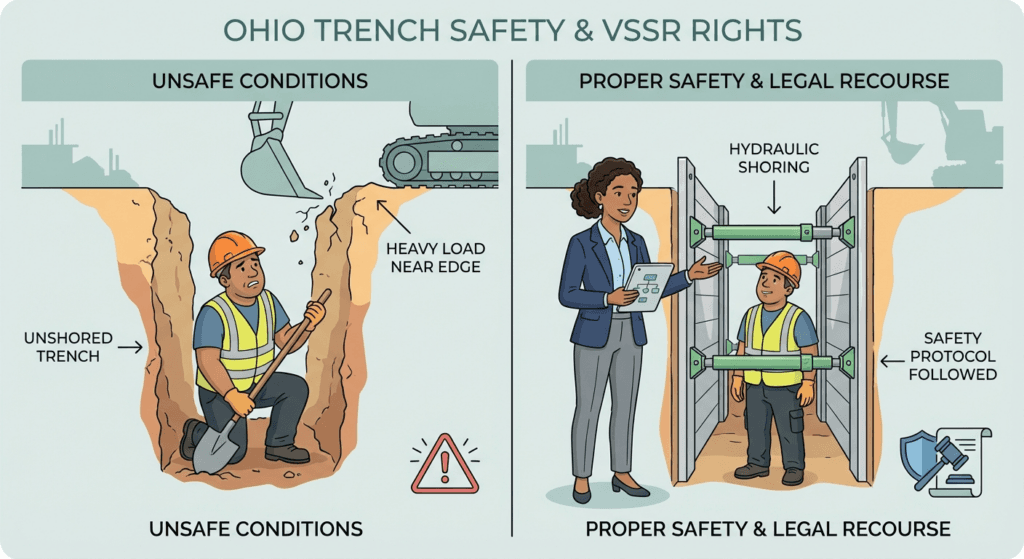
- Superimposed Loads: Heavy vehicles or equipment operating near a trench edge, causing walls to fail under extra pressure
- Shoring Failures: Inadequate, improperly installed, or entirely absent shoring and bracing systems
- Falls: Workers or equipment falling into unprotected excavations
- Vibrations: Ground failure caused by nearby highway traffic or heavy machinery
- Falling Objects: Materials or “spoils” stored too close to the trench edge, falling onto workers below
- Crush Injuries: Workers caught in a collapse while working in or near the trench
Ohio’s Specific Safety Rules for Trenching and Excavation
Ohio construction employers are subject to mandatory safety requirements under Ohio Administrative Code Rule 4123:1-3-13. Key protections include:
- The Five-Foot Rule: Exposed faces of trenches more than 5 feet deep must be shored, sloped, or otherwise protected where employees may be exposed to cave-ins. Note that protection may be required at shallower depths in unstable soil.
- The Two-Foot Rule: Excavated material (spoils) must be placed at least 24 inches from the top edge of the trench to prevent edge collapse and falling hazards.
- Superimposed Loads: If heavy objects — such as excavators, trucks, or materials — are placed on a level above and near an excavation, the side must be sheet-piled, shored, braced, or sloped to resist the extra pressure.
- Safe Egress: In trenches 4 feet or deeper, an adequate means of exit (ladder or ramp) must be provided within 25 feet of lateral travel for employees.
- Walkways: Guarded bridges or walkways must be provided where employees are required to cross over excavations.
- Vibration Precautions: Where trenches are adjacent to backfilled areas or subjected to vibrations from traffic or machinery, additional shoring and bracing must be provided to prevent slides or cave-ins.
A Landmark Shift: State ex rel. Berry v. Industrial Commission (2025)
In October 2025, the Ohio Supreme Court issued a pivotal ruling in State ex rel. Berry v. Industrial Commission of Ohio (2025-Ohio-4720). A utility worker was injured when a piece of asphalt detached from the side of a Columbus-area trench where he was working — while a large excavator and dump truck were positioned above and near the trench with no shoring in place.
This decision changed the landscape for injured workers in two important ways:
- “Heavy Objects” Broadly Defined. The Court clarified that the safety rule requiring shoring when heavy objects are placed above and near an excavation is not limited to traditional “power shovels.” A large excavator qualifies as a heavy object under OAC 4123:1-3-13(E)(7). Employers can no longer argue only certain equipment triggers the shoring requirement.
- End of Mandatory Deference. Following the logic of the U.S. Supreme Court’s Loper Bright Enterprises v. Raimondo (2024), Ohio courts must now independently interpret safety rules rather than automatically deferring to the Industrial Commission’s often narrow or pro-employer readings. This is a significant shift that can benefit injured workers when the Commission has wrongly denied a VSSR application.
VSSR Awards: The 15% to 50% Penalty
A VSSR award is a penalty paid directly by the employer to the injured worker, in addition to all standard workers’ compensation benefits.
- The Percentage: The Industrial Commission awards between 15% and 50% based on the seriousness of the employer’s violation.
- The Calculation: This percentage is applied to the maximum weekly compensation rate for the year of the injury — not the worker’s individual wage rate.
- Example: If the maximum weekly rate for the year of injury is $1,200 and the Commission awards a 50% VSSR, the worker receives an extra $600 per week for every week of compensation paid in the claim.
- Retroactive Lump Sum: Because VSSR claims take time to investigate and hear, workers typically receive a large retroactive lump sum covering all weeks of compensation already paid, followed by an ongoing add-on to future compensation checks.
Evidence Checklist: Protecting Your VSSR Claim
Construction sites change by the hour. Documenting the scene immediately is critical. To support a VSSR claim, try to secure:
- Photographs: Clear photos of the trench depth, the absence of shoring, and the proximity of heavy equipment or spoil piles to the trench edge
- Measurements: The exact depth of the trench and the distance of equipment or materials from the opening
- Witness Information: Names and contact information for co-workers or bystanders who observed equipment positioning or heard safety concerns raised before the accident
- OSHA Records: Any OSHA citations issued in connection with the incident are powerful evidence at a VSSR hearing
⚠️ Critical Deadline: You Only Have ONE Year from the Date of Injury to File Your VSSR Claim
For all injuries occurring on or after September 15, 2020, Ohio law (H.B. 81) reduced the VSSR filing deadline from two years to one year from the date of injury. Missing this deadline means losing the VSSR award entirely — regardless of how strong your case may be. Do not wait.
Frequently Asked Questions
What is a VSSR claim in Ohio?
A VSSR (Violation of a Specific Safety Requirement) is an additional award on top of standard Ohio workers’ compensation benefits, paid directly by the employer when they violated a specific Ohio safety rule that caused your injury. It is a separate, distinct award — in addition to all other compensation you are entitled to receive.
How long do I have to file a VSSR claim in Ohio?
You have only ONE year from the date of injury to file a VSSR application in Ohio. Missing this deadline means losing the VSSR award entirely, regardless of how strong your case may be. Do not wait — contact an Ohio workers’ compensation attorney immediately.
What safety rules apply to trench and excavation work in Ohio?
Ohio Administrative Code Rule 4123:1-3-13 governs construction trenching and excavation. Key requirements include:
Key protections include:
-
The Five-Foot Rule: Exposed faces of trenches more than 5 feet deep must be shored, laid back to a stable slope, or otherwise protected where employees may be exposed to moving ground or cave-ins. Note that protection may be required at shallower depths if the soil is unstable.
-
The Two-Foot Rule: Excavated material (spoils) must be placed at least 24 inches from the top edge of the trench to prevent edge collapse and falling hazards.
-
Superimposed Loads: If heavy objects—such as excavators, trucks, or materials—are placed or operated on a level above and near an excavation, the side must be sheet-piled, shored, braced, or sloped as necessary to resist the extra pressure.
-
Safe Egress: In trenches 4 feet or deeper, an adequate means of exit (such as a ladder or steps) must be provided and located so as to require no more than 25 feet of lateral travel for employees.
-
Walkways: Guardrails must be provided on walkways or bridges used to cross over excavations that are 6 feet deep or more.
-
Vibration Precautions: Where trenches are adjacent to backfilled areas or subjected to vibrations from traffic or machinery, additional shoring and bracing must be provided to prevent slides or cave-ins.
How much is a VSSR award worth in Ohio?
The Ohio Industrial Commission awards between 15% and 50% of the maximum weekly compensation rate for the year of injury. This is paid in addition to all other workers’ compensation benefits — typically as a retroactive lump sum covering all weeks of compensation already paid, plus an ongoing weekly add-on to future compensation checks. The employer pays the VSSR award directly, not the Ohio BWC.
Contact Gruhin & Gruhin
Mike Gruhin is a Board Certified Specialist in Ohio Workers’ Compensation Law (certified 1999-2030) with decades of experience representing injured workers in amputation, loss of use, VSSR, disfigurement claims, intentional tort and 3rd party claims. Board Certification is the highest recognition the Ohio State Bar Association confers.
If you or someone you love has been seriously injured at work in Ohio — especially in a machine accident, an amputation, a fall from height, or any injury involving equipment that may have been defective or improperly guarded — do not assume you only have a workers’ compensation claim. You may have much, much more.
Call Mike directly at (216) 861-5555, option 1
Read Mike’s free guide: The Officially Unofficial Injured Worker’s Guide to Ohio Workers’ Compensation — no cost, no obligation.
Ready to fight back? You don’t have to figure this out alone.
Contact Mike Gruhin for Your Free Consultation
The consultation is free, the information is free, and the conversation could change your life.
If you or someone you know has been injured at work and is struggling to move forward, you may have more legal options than you realize.
📞 216-861-5555
🌐 https://www.gruhin.com
📋 https://www.gruhin.com/contact
⚖️ Mike Gruhin — OSBA Board Certified Ohio Workers’ Compensation Specialist Attorney
(Certified 1999–2030).
Board Certification means exceptional competence, experience, and professionalism in workers’ comp law — recognized by the Ohio State Bar Association.
Mike Gruhin and Gruhin & Gruhin, LLC — Fighting for injured workers across Ohio.