The Machine Amputated Your Finger, Hand, Arm, Foot or Leg.
Did Your Employer’s or a Third-Party’s Negligence Take the Rest?
What Ohio’s Most Seriously Injured Workers Don’t Know About the Full Value of their Ohio Injury Claims.
Every day in Ohio, workers are seriously injured — on machines, on job sites, in warehouses and factories — and they file a workers’ compensation claim. They do what they are told. They follow the process and try to rebuild their lives.
What many never hear is this: the BWC claim is only one piece of the legal picture. They never find out that they may have been entitled to significantly more money — sometimes dramatically more — than what the Ohio BWC paid them.
That isn’t because anyone is hiding the law. It’s because workers’ compensation was never designed to include every category of civil damages after a catastrophic injury.
Additionally, the Ohio BWC system was never designed to fully educate you and trying to handle your claim without an experienced Ohio Workers’ Compensation lawyer – a lawyer who knows where to look for the additional claims and injury awards that could change your financial future – simply go unfiled, expire, and disappear forever.
This article is intended to educate you about those additional claims, but only if you act on time.
- The ones that are hidden in plain sight.
- The ones that can mean the difference between a family that survives a tragedy — and one that is financially destroyed by it.
- The ones that determine whether a seriously injured worker receives the full measure of justice they deserve — or walks away with a fraction of what they are owed.
- The ones that can transform a life-altering injury from a permanent hardship into a recovery with real dignity and security — if you act in time
- The ones that separate a worker whose life is rebuilt from one whose injury never stops taking
The ones that can turn a routine BWC case into the most important financial decision of your life — but only if you act in time.
The BWC System: Powerful — But Intentionally Limited
Ohio’s workers’ compensation system is a no-fault system. You don’t need to prove your employer did anything wrong to receive benefits. That’s its great advantage — and its built-in core limitation. Because it doesn’t require fault, it was never designed to fully compensate you for what happened.
The BWC does not pay for pain and suffering. It does not pay your full wage — only a percentage. It does not punish employers who behave dangerously or recklessly. It does not punish third-party individuals or third-party companies who cause your injuries.
The Ohio BWC only pays an injury formula, based on its statutory rate chart. The Ohio BWC formula was designed to be manageable for the Ohio Workers’ Compensation system — not to make you whole. Not only that, benefits are not automatic. You must always file documentation seeking the benefits you are owed.
For 2026, the Ohio BWC maximum weekly compensation rate for Temporary Total Disability (TTD) is $1,281 per week — with a minimum of $427 per week. These rates apply to injuries occurring on or after January 1, 2026. For injuries in prior years, the applicable rate is the rate in effect for the year of injury.
The BWC system is the floor — not the ceiling. For many seriously injured Ohio workers, there is a much higher ceiling. Getting there requires knowing what to look for — and having the right OSBA Board Certified Workers’ Compensation Lawyer in your corner before the clock runs out.
⚙️ Machine Injuries and Amputations: When the BWC Claim Is Only the Beginning
Amputations and crush injuries caused by machines and workplace injuries in Ohio are among the most devastating — and result in the most legally complex — legal claims. When a machine injures a worker and results in an amputation, crush injury, or permanent disfigurement, the instinct is to file a BWC claim and try to move forward. That instinct, while understandable, may be costing the injured worker a fortune.
Ohio’s BWC Scheduled Loss chart sets fixed compensation for the loss of specific body parts. For injuries in 2026, the values include:
- Loss of a hand: 175 weeks × $1,281 = $224,175
- Loss of an arm: 225 weeks × $1,281 = $288,225
- Loss of a leg: 200 weeks × $1,281 = $256,200
- Loss of a foot: 150 weeks × $1,281 = $192,150
- Loss of an eye: 125 weeks × $1,281 = $160,125
These are meaningful numbers. But they are only what the BWC pays — and they do not include pain and suffering, full wage loss, or any civil damages. In a machine injury case where additional claims are available, the BWC scheduled loss award may represent only a fraction of the total compensation the injured worker is legally entitled to receive.
Machine injury cases in Ohio often involve multiple layers of potential liability beyond the BWC:
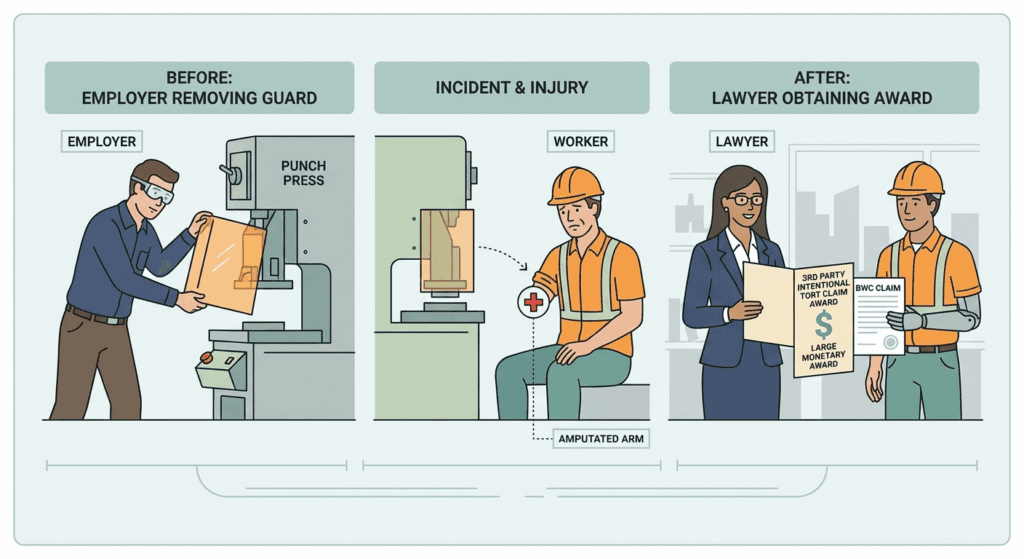
- Was the machine’s safety guard removed or disabled? That may trigger Ohio’s intentional tort statute.
- Was the machine defectively designed or manufactured? A product liability claim against the manufacturer may be available — entirely outside the BWC system.
- Was the machine maintained by a third-party contractor? A negligence claim against that contractor may be available.
- Was the machine modified by your employer in a way that eliminated a safety feature? That may support both an intentional tort claim and a VSSR award.
No one walking through the BWC office alone is going to identify all of those claims. Only an experienced attorney will.
🔧 Tampered Machines and the Ohio Intentional Tort: Outside the BWC — And Potentially Worth Millions
Ohio’s workers’ compensation system is generally the exclusive remedy against your employer for a work injury. You ordinarily cannot sue your employer in civil court. But Ohio law creates a narrow and extraordinarily powerful exception: the Employer Intentional Tort under Ohio Revised Code Section 2745.01.
An intentional tort lawsuit is filed in the Ohio Court of Common Pleas — entirely separate from the BWC claim — and it opens the door to full civil damages that the workers’ compensation system simply does not provide:
- Compensation for pain and suffering
- Full wage replacement (not just two-thirds)
- Punitive damages in appropriate cases
- Loss of consortium claims for a spouse
- All other compensatory damages available in an Ohio civil action
To prevail, an injured worker must prove that the employer committed a tortious act with the intent to injure, or with the belief that injury was substantially certain to occur — defined under ORC 2745.01(B) as acting with deliberate intent to cause an employee to suffer an injury, a disease, a condition, or death. Ohio courts have interpreted this standard strictly, making these cases challenging but far from impossible.
The most powerful provision in the statute is found in ORC 2745.01(C):
The deliberate removal by an employer of an equipment safety guard creates a rebuttable presumption that the removal was committed with intent to injure — if an injury occurs as a direct result.
In plain terms: if your employer deliberately removed a physical safety guard from a machine and you were injured as a result, Ohio law presumes the employer intended to hurt you. The employer can try to rebut that presumption — but the burden shifts to them. This presumption is the gateway to a full civil lawsuit for damages that can dwarf the entire value of a BWC claim.
Consider what this means in a real case: a jury recently awarded $1.9 million to an injured worker whose employer removed a safety guard from a sand spreader and never replaced it (Camara v. Gill Dairy, argued before the Ohio Supreme Court in March 2025). The worker also collected BWC benefits. The intentional tort verdict was separate and additional.
Statute of limitations — do not miss this: An intentional tort claim under ORC 2745.01 is subject to a one-year statute of limitations under ORC 2305.112 — running from the date of injury. This is shorter than the general two-year personal injury deadline and catches many injured workers completely off guard. Miss this one-year window and the civil lawsuit is barred permanently, no matter how strong the facts. Evidence disappears. Safety guards get repaired or replaced. Witnesses move on. The time to act is now — not after the BWC claim resolves, and not next year.
🦺 Violation of Specific Safety Requirements (VSSR): Money Paid Directly by Your Employer
Even when an intentional tort claim is not available, Ohio law provides another powerful tool: the Violation of Specific Safety Requirement (VSSR) claim under ORC Section 4121.47.
A VSSR award is a separate, additional award of compensation — on top of all regular BWC benefits — paid directly out of the employer’s own pocket when the employer violated a specific Ohio safety rule that caused your injury. It is not paid from the state workers’ compensation fund. It is not subject to settlement through the BWC. It is a penalty assessed directly against the employer by the Ohio Industrial Commission.
The VSSR award ranges from 15% to 50% of the maximum allowable weekly compensation rate for the year of injury. For a 2026 injury at the maximum weekly rate of $1,281:
- 15% VSSR award = an additional $192.15 per week
- 50% VSSR award = an additional $640.50 per week
On a serious injury claim running for months or years, a 50% VSSR award adds up to tens of thousands of dollars — paid directly by the employer. And if the employer has been cited for two or more VSSR violations within 24 months, the Ohio Industrial Commission can impose an additional penalty of up to $50,000 against them.
VSSR claims can arise from a wide range of employer safety failures including failure to provide fall protection, failure to guard machines, failure to implement lockout/tagout procedures, failure to provide required personal protective equipment, scaffolding violations, electrical safety violations, and many others under the Ohio Administrative Code.
Critical deadline — do not miss this: A VSSR application (Form IC-8/9) must be filed with the Ohio Industrial Commission within one year of the date of injury. It is a completely separate filing from your BWC claim. Miss this deadline and the VSSR claim is extinguished permanently. The BWC will not remind you. Your employer will not tell you. Only your attorney will know to file it.
🏭 Third-Party Claims: When Someone Else Is Also Responsible
Ohio’s workers’ compensation system prevents you from suing your employer for negligence — but it does not prevent you from suing a third party whose negligence contributed to your injury. Third-party claims are filed in civil court, completely separate from the BWC, and they are not subject to any workers’ compensation limitations on damages.
Common third-party scenarios include:
- Defective machine manufacturer, Integrator, or Distributor: If the machine that injured you was defectively designed or manufactured, the manufacturer, machine integrator, and/or distributor face a product liability claim— regardless of whether a safety guard was removed.
- Outside Maintenance Contractor
- Negligent contractor or subcontractor: If a third-party contractor created or failed to correct the dangerous condition that caused your injury, they can be sued directly.
- Property owner: If you were injured on property owned by someone other than your employer, the property owner may bear independent liability.
- Negligent driver: If your work injury involved a vehicle accident caused by another driver, a personal injury claim against that driver is available in addition to your BWC claim.
Third-party claims allow recovery for pain and suffering, full wage loss, and all other civil damages. In serious injury cases, the third-party claim can be worth more than the BWC claim many times over.
💰 The Full Picture: What These Claims Are Worth Together
Here is what the picture looks like in a serious machine injury case with multiple claims available — using 2026 BWC rates:
- BWC scheduled loss (hand amputation): 175 weeks × $1,281 = $224,175 — plus medical coverage for life of claim
- VSSR award at 50%: $640.50/week additional, paid directly by employer, for the duration of compensation — potentially $50,000 to $100,000+ on a long-running claim
- Intentional tort civil verdict or settlement: Full pain and suffering, full wage loss, punitive damages — potentially $500,000 to several million dollars depending on the facts
- Product liability / third-party claim: Full civil damages in addition to all of the above
Filing only a BWC claim when more is available is not just leaving money on the table. It’s letting the person/entity who deliberately endangered you walk away without consequence — while you live with the injury, the limitations, and the losses every single day.
😟 “I Can’t Afford an Attorney” can become a costly assumption.
This is the single most costly misconception among Ohio injured workers. Here is the reality.
Ohio workers’ compensation attorneys work on contingency. You pay nothing upfront. No retainer. No hourly rate. No filing fees. Your attorney only gets paid if you receive compensation — and the fee comes out of what is recovered, not out of your own pocket. No recovery, no attorney fee.
The contingency fee structure exists because these cases require experts, preservation work, and litigation resources that most families cannot fund out of pocket.
The real question is not whether you can afford an attorney. The question is how much money you are leaving on the table by not having an attorney. The BWC is an administrative system that pays what the formula requires. It will not identify your VSSR claim. It will not tell you that you may have an intentional tort claim to pursue, it will not evaluate your intentional tort case. It will not investigate the machine manufacturer. Only your attorney will do those things — and only if you call before the deadlines pass.
⏱️ Every Claim Has a Deadline — and the Clock Is Already Running
- VSSR claim: 1 year from date of injury — file Form IC-8/9 with the Ohio Industrial Commission
- Intentional tort (ORC 2745.01): 1 year from date of injury under ORC 2305.112 — file in Ohio Court of Common Pleas. This is shorter than the general personal injury deadline and is frequently missed.
- Product liability / third-party negligence: 2 years from date of injury under ORC 2305.10
Evidence disappears. Safety guards get repaired. Machines get scrapped or modified. Witnesses forget or move away. The sooner an experienced Ohio Workers’ Compensation lawyer evaluates your case, the better your chances of preserving everything needed to pursue the recovery of the full value of your claim.
Call Mike Gruhin Before You Assume You Only Have a BWC Claim
Mike Gruhin — OSBA Board Certified Ohio Workers’ Compensation Specialist lawyer for over 27 years (1999–2030) — knows how to look at a serious work injury case and identify every avenue of compensation available. Not just the BWC claim everyone sees — but the VSSR claim, the intentional tort claim, the product liability claim, and the third-party claims that most injured workers never know exist.
If you or someone you love has been seriously injured at work in Ohio — especially in a machine accident, an amputation, a fall from height, or any Ohio workplace injury involving machinery, punch press, or heavy equipment that may have been defective or improperly guarded — do not assume you only have a workers’ compensation claim. You may have much, much more.
Call Mike directly at (216) 861-5555, option 1 or Contact Mike Gruhin Online Here. The consultation is free, the information is free, and the conversation could change your life.
Read Mike’s free guide: The Officially Unofficial Injured Worker’s Guide to Ohio Workers’ Compensation — no cost, no obligation.
Ready to fight back? You don’t have to figure this out alone.
Contact Mike Gruhin for Your Free Consultation
If you or someone you know has been injured at work anywhere in Ohio and are unsure whether or not your Ohio injury is only an Ohio BWC claim and is struggling to move forward in your injury claim, you may have more legal options than you realize.
📞 216-861-5555
🌐 https://www.gruhin.com
📋 https://www.gruhin.com/contact
⚖️ Mike Gruhin — OSBA Board Certified Ohio Workers’ Compensation Specialist Attorney
(Certified 1999–2030).
Board Certification means exceptional competence, experience, and professionalism in workers’ comp law — recognized by the Ohio State Bar Association.
Mike Gruhin and Gruhin & Gruhin, LLC — Fighting for injured workers across Ohio.