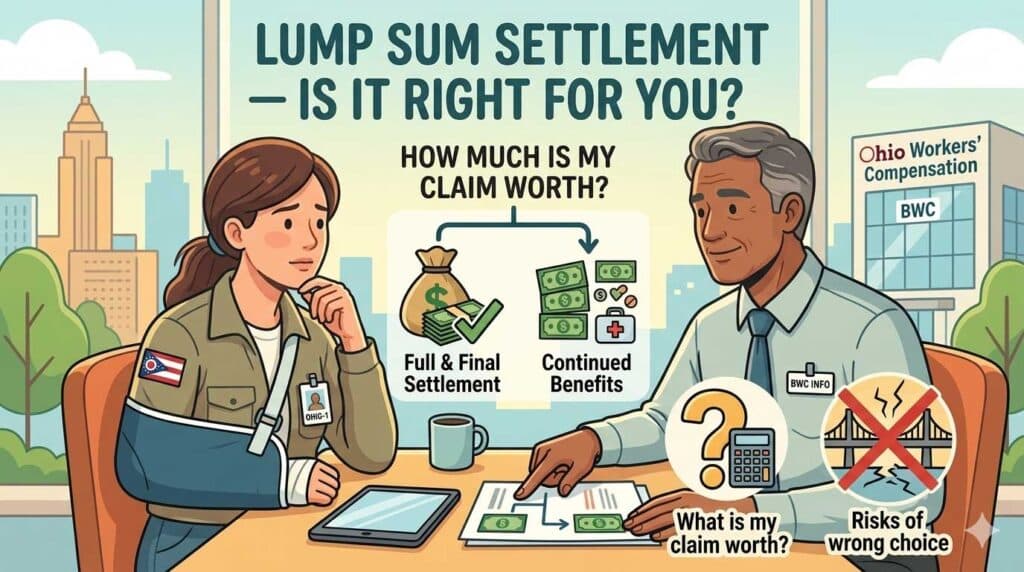
Ohio Workers’ Compensation Lump Sum Settlement — Is It Right for You?
Every day, injured Ohio workers ask the same question: What is my workers’ compensation claim worth, and when should I settle it? It is one of the most important financial decisions an injured worker will ever make — and it is also one of the most dangerous to get wrong.
Here is the hard truth: no internet search will ever tell you what your specific claim is worth. No formula. No calculator. No online guide.
Every Ohio workers’ compensation claim is unique in its facts, its medical history, its benefit exposure, and its legal risk. The only person qualified to give you a reliable settlement valuation is a Board Certified Ohio Workers’ Compensation Specialist Attorney — someone who has evaluated thousands of claims and knows exactly what the Ohio BWC is looking at when it decides what to offer.
What follows is a plain-English breakdown of everything you need to understand before you consider settling your Ohio workers’ compensation claim — including the traps that can cost you everything.
Settlement Is Always Voluntary — But “Voluntary” Doesn’t Mean Simple
Under Ohio law (ORC Section 4123.65), a workers’ compensation settlement is purely voluntary. The Ohio BWC does not have to agree to settle your claim. You do not have to accept any offer made by the BWC or your employer. And once a settlement agreement is reached, any party has 30 days (the cooling-off period) to withdraw — after which the settlement becomes final and binding with no exceptions and no do-overs.
Once that 30-day window closes, your claim is settled. You cannot reopen it. You cannot go back and argue that the settlement was too low. The rights you gave up are gone permanently. That finality is exactly why getting this right — the first time — matters so much.
What Benefits Are You Giving Up? Know What You’re Trading Away.
Before you can evaluate whether a settlement offer is fair, you must understand what you are actually giving up. A full settlement of an Ohio BWC claim typically resolves all of the following:
Temporary Total Disability (TTD) — If you are still unable to work, future TTD payments are factored into your settlement value. The anticipated duration and future value of those payments is a major driver of settlement amount.
Wage Loss Compensation — If your injury limits your ability to earn your pre-injury wage, you may be entitled to working wage loss or non-working wage loss. This is a substantial benefit that must be properly calculated in any settlement demand.
Permanent Partial Disability (PPD) — If your injury resulted in a permanent impairment, you are entitled to seek PPD compensation at any time during the life of the claim. You can seek increases to your PPD award as your condition worsens. The current and future value of this benefit must be factored into your demand.
Permanent Total Disability (PTD) — If your injury is so severe that you cannot return to any form of sustained employment, you may, in the future, pursue PTD benefits, or you may be receiving PTD benefits — a lifetime benefit. Settling a PTD claim is among the most complex and consequential decisions in Ohio workers’ compensation law and should never be approached without an experienced attorney.
Future Medical Treatment — In a full settlement, you typically give up the right to future medical care for the settled conditions. This is perhaps the most underestimated risk in any settlement, particularly for injured workers on Medicare or with progressive or degenerative conditions. Once medical is settled and closed, the BWC will not pay for any future treatment related to those conditions — regardless of how much your condition worsens.
⚠️ Are You 62½ or Older? On Medicare, a Medicare Advantage Plan, or Medicaid? Read This Carefully.
This is where Ohio workers’ compensation settlements get genuinely dangerous for a large segment of injured workers — and where the stakes are highest. If you are age 62½ or older, currently enrolled in Medicare (traditional or Advantage), or receiving Medicaid, a full lump sum settlement of your BWC claim requires careful, expert navigation. Getting this wrong can cost you your Medicare or Medicaid coverage, can result in significant out-of-pocket medical expenses, or expose you to Medicare, Medicare Advantage Plan, and/or Medicaid liability.
The Medicare Set-Aside (MSA) Requirement
Under the federal Medicare Secondary Payer Act, Medicare is always a secondary payer — meaning that when a workers’ compensation settlement includes future medical benefits, those future medical costs must be accounted for before Medicare will step in and pay. The mechanism for doing this is a Workers’ Compensation Medicare Set-Aside Arrangement (WCMSA) — a separately administered account funded from your settlement proceeds that must be exhausted on injury-related medical care before Medicare pays anything.
As of the current CMS guidelines (WCMSA Reference Guide v4.4, updated July 2025), CMS review of a proposed WCMSA is triggered when:
- You are a current Medicare beneficiary and the total settlement exceeds $25,000; or
- You have a reasonable expectation of Medicare enrollment within 30 months of the settlement date and the anticipated total settlement exceeds $250,000
Critical warning: These dollar thresholds are workload review thresholds — not safe harbors. CMS has made clear that settling below these amounts does not give injured workers permission to ignore Medicare’s interests. If your settlement forecloses future medical responsibility, Medicare’s interests must be considered and protected regardless of the settlement amount. Failing to do so can still result in Medicare refusing to pay future injury-related claims and pursuing recovery against you.
Why does this matter? Because if Medicare’s interests are not properly addressed, Medicare can refuse to pay for any future injury-related medical care — leaving you to pay out of pocket — and can pursue recovery against you for any injury-related care it paid after your settlement. The penalties for non-compliance are serious, and CMS has significantly expanded its enforcement posture.
Important 2025 CMS update: Effective April 4, 2025, CMS now mandates Section 111 reporting of WCMSA data for all settlements involving Medicare beneficiaries — including those below the $25,000 review threshold. Failure to comply can result in penalties up to $365,000 and may cause CMS to refuse to recognize the underlying settlement entirely. This is a major new enforcement development that affects every Medicare-involved settlement in Ohio.
Also effective July 17, 2025: CMS will no longer accept or review zero-dollar ($0) MSA proposals. This closes a strategy that was sometimes used in prior settlements and further tightens the compliance landscape.
Why does this matter? Because if a proper MSA is not established when required, Medicare can refuse to pay for any future injury-related medical care — leaving you to pay out of pocket — and can pursue recovery against you for any injury-related care it paid after your settlement. The penalties for non-compliance are serious, and CMS has significantly expanded its enforcement posture.
Medicare Advantage (Part C) Plans — A Hidden Trap
Many injured workers assume that because they are on a Medicare Advantage plan — rather than traditional Medicare — the MSA rules do not apply to them. This assumption is wrong and potentially catastrophic. Medicare Advantage plans are still Medicare. They are governed by the same Medicare Secondary Payer rules, and your Advantage plan insurer has its own independent lien rights against your settlement proceeds for any injury-related care it paid. Failing to identify, negotiate, and resolve a Medicare Advantage plan lien before settlement can result in the plan demanding full repayment — sometimes years after your settlement is finalized.
Medicaid Liens
If you receive Medicaid benefits and Medicaid paid for any medical treatment related to your work injury, Ohio’s Medicaid program holds a statutory lien against your settlement proceeds. Under Ohio law, that lien must be resolved as part of any settlement. Ignoring a Medicaid lien does not make it go away — it gives the Ohio Department of Medicaid the right to recover from your settlement funds, and in some cases, to seek repayment even after the money has been spent. Identifying and properly negotiating Medicaid liens requires experience and knowledge of both state and federal law.
When a Full Settlement May Not Be the Right Move: The Indemnity-Only Settlement
Here is something the Ohio BWC’s own settlement information page does not adequately explain: a full settlement is not your only option.
An indemnity-only settlement resolves the compensation portion of your claim — TTD, wage loss, PPD, PTD — while leaving the medical component of your claim open. This means the BWC continues to pay for your injury-related medical treatment even after the settlement is paid.
For injured workers who are Medicare-eligible or Medicare-enrolled, an indemnity-only settlement offers a critical advantage: because medical benefits remain open, there is no need to establish a Medicare Set-Aside trust. This eliminates one of the most complex and expensive aspects of a full settlement, and protects your access to ongoing injury-related medical care through the BWC rather than forcing you to exhaust a set-aside account.
An indemnity-only settlement is not always appropriate — the BWC will typically offer less because it retains ongoing medical liability — but in many cases involving Medicare or Medicaid, it is the smarter, safer choice. Only an experienced Board Certified Workers’ Compensation Specialist Attorney can evaluate whether it makes sense in your specific situation.
One More Critical Point: Your Claim Expires at Your Death
An Ohio workers’ compensation claim is a personal right — it does not automatically pass to your family. If you die while your claim is still open and unsettled, the claim generally dies with you. Your family receives nothing from the unsettled claim value.
However, if a settlement has been reached, the 30-day cooling-off period has expired, and you passed away after the 30-day cooling-off period has expired, then the settlement funds become part of your estate and pass to your heirs. This distinction matters enormously for injured workers whose health is uncertain or declining. If that describes your situation, a settlement discussion with a specialist attorney is not optional — it is urgent.
What Mike Gruhin Does That the BWC Does Not
The Ohio BWC makes it clear that you do not need an attorney to settle your claim. What the BWC does not tell you is what an unrepresented injured worker consistently leaves on the table:
- Possible Wage recalculation: Many injured workers’ average weekly wages were set incorrectly at the time of injury. A recalculation can result in a lump-sum award of past underpaid compensation — money you are already owed.
- Potential Additional condition allowances: Allowing new conditions in your claim increases its value and can open new avenues for TTD, additional PPD, and expanded medical coverage.
- Potential Wage Loss Compensation: Reviewing the claim to determine whether or not wage loss is being paid, or may be obtainable at some future point, in the claim.
- Potential Success at Obtaining PTD: Calculating settlement value based on potentially obtaining PTD.
- Medicare and Medicaid lien resolution: Identifying, negotiating, and resolving government liens requires expertise the BWC is not going to provide on your behalf.
- True settlement valuation: The BWC evaluates what it thinks it owes. Mike evaluates what you are actually entitled to — and those numbers are rarely the same.
Call Mike Gruhin Before You Sign Anything
Mike Gruhin — OSBA Board Certified Specialist in Ohio Workers’ Compensation for over 30 years (1999–2030) — has guided thousands of Ohio injury victims through the settlement process, protecting their interests at every step. Whether you are considering a full settlement, an indemnity-only settlement, or simply want to know what your claim is really worth, Mike will give you a straight answer — including telling you when settlement is not in your best interest.
Read Mike’s free guide: The Officially Unofficial Injured Worker’s Guide to Ohio Workers’ Compensation — no cost, no obligation.
Ready to fight back? You don’t have to figure this out alone.
Contact Mike Gruhin for Your Free Consultation
The consultation is free, the information is free, and the conversation could change your life.
If you or someone you know has been injured at work and is struggling to move forward, you may have more legal options than you realize.
📞 216-861-5555
🌐 https://www.gruhin.com
📋 https://www.gruhin.com/contact
⚖️ Mike Gruhin — OSBA Board Certified Ohio Workers’ Compensation Specialist Attorney
(Certified 1999–2030).
Board Certification means exceptional competence, experience, and professionalism in workers’ comp law — recognized by the Ohio State Bar Association.
Mike Gruhin and Gruhin & Gruhin, LLC — Fighting for injured workers across Ohio.
DISCLAIMER: By accessing any website page or website post, the reader agrees that (1) The information above is general in nature and is not legal advice; (2) No attorney-client relationship is created; (3) Each claim is unique and must be carefully evaluated on its specific facts under current Ohio law and the most recent court decisions; and, (4) Such evaluations require advice from an experienced Ohio Workers’ Compensation Attorney.