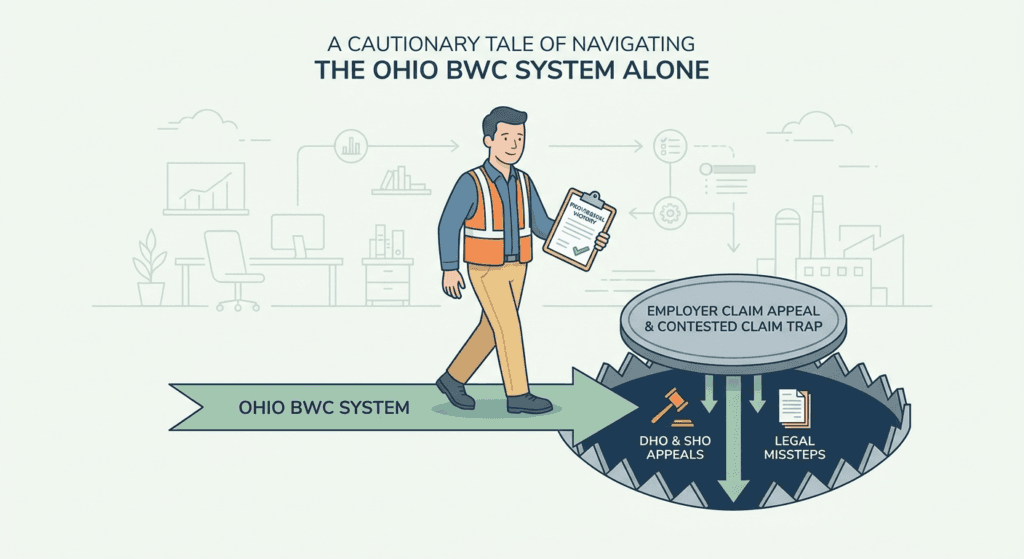
A Cautionary Tale of Navigating the Ohio BWC System Alone
Why a single misstep in a contested claim can turn a provisional victory into a devastating dead end.
● DHO & SHO Appeals
● Legal Representation
Many injured workers believe that filing an Ohio Bureau of Workers’ Compensation (BWC) claim is straightforward—until reality sets in. They assume that if they are genuinely hurt on the job, the system will naturally take care of them. Unfortunately, as many discover too late, navigating the BWC without legal representation is a high-stakes gamble where a single misstep can permanently derail a legitimate claim.
Consider the case of an Ohio worker injured on March 10, 2026. Initially, he felt confident handling the claim on his own. In his mind, everything was going smoothly – his medical treatment was approved, but with disclaimers – and he went to his appointments. But beneath the surface, his claim was languishing in a contested status, quietly heading toward a cliff. His employer was fighting the claim.
The Danger of the “Disclaimed” Treatment Request
When a claim is contested, injured workers often run into a frustrating roadblock: no treatment is officially allowed.
If your Physician of Record (POR) submits a request for medical authorization while the claim is contested or unallowed, the managed care organization (MCO) or employer will issue approval, but with an Ohio BWC disclaimer.
What does this Ohio BWC Disclaimer mean in practice?
- Provisional Status: The disclaimer essentially states that the treatment is being authorized provisionally. No payment for the medical treatment is made and if the claim is ultimately denied or the condition is not officially allowed, the financial responsibility can fall back on the patient. Payment for services or diagnostic testing is contingent entirely upon the future allowance of the claim or the requested claim condition.
- False Security: Approval with disclaimer creates a false sense of security. The injured worker sees “authorization” and thinks they are safe to receive care, failing to realize that without a legally recognized allowance for the specific medical condition, they have zero legal foundation to get the bill paid through the Ohio Bureau of Workers’ Compensation claim.
Need Help Navigating the Process?
Need legal representation for your Ohio Workers’ Compensation Claim, contact Mike Gruhin for your Free, No-Obligation Consultation.
The DHO Hearing and the Employer’s Appeal
Eventually, the worker’s case reached a District Hearing Officer (DHO) hearing level at the Ohio Industrial Commission. Following the hearing process—where evidence is presented, arguments are weighed, and the legal merits of the injury are evaluated—the worker scored a temporary victory: he was granted allowance for a torn rotator cuff.
For a moment, it felt like vindication. But in the Ohio workers’ compensation system, a DHO win is rarely the final word when an employer contests the claim. And, his employer promptly appealed the decision to the Staff Hearing Officer (SHO) level.
Along with the employer’s appeal came a dense, critical piece of evidence: the employer scheduled a medical exam and received report critical to the claim and supportive of the employer’s contesting the claim. This document was designed to dismantle the worker’s case, arguing that the torn rotator cuff was pre-existing, degenerative, or unrelated to the workplace incident.
The 11th-Hour Panic and the Reality of the SHO Hearing
The Ohio Industrial Commission set the employer’s appeal for hearing. With the clock ticking down, the injured worker called just 6 days before his scheduled Staff Hearing Officer (SHO) appeal. He admitted he had no idea what the employer’s medical report said, nor did he know how to legally counter it. He felt that because he succeeded at the first hearing he would win the appeal on his own and without a lawyer. Interestingly, the employer’s medical exam took place after the initial DHO hearing. Now the claim took on a totally different complexion. Yet, this injured worker was only concerned with what a lawyer might charge and disregarded the extreme danger of losing his entire claim at the SHO appeal level.
This is where the procedural gravity of the Industrial Commission of Ohio (IC) becomes absolute:
- The Stakes: If the injured worker loses at the SHO level, the claim faces functional denial.
- The Dead End: While a third-level appeal exists to the Industrial Commission itself, Industrial Commissioners typically refuse to accept appeals from an SHO decision, making the SHO hearing effectively the last administrative stop.
- The Courtroom Alternative: Once the administrative path closes, the only remaining recourse is filing an administrative appeal into the Court of Common Pleas—turning a workers’ compensation claim into a complex, stressful civil lawsuit requiring formal litigation. At the point where the un-represented injured worker loses the Staff Hearing, most likely, no attorney would be willing to take on the representation of the claim and the injured worker winds up with nothing but a denied claim. No medical and no compensation.
Free Compensation Manual
Download our comprehensive guide, the Officially Unofficial Guide to Ohio Workers’ Compensation, to maximize your recovery paths and avoid costly administrative pitfalls.
The Conversation No One Wants to Have
Faced with this perilous timeline, the guidance given to the worker was blunt and absolute: He needed to hire a qualified Ohio workers’ compensation lawyer immediately to represent him at the upcoming SHO hearing.
Yet, the conversation derailed over a fundamental misunderstanding of how legal fees work.
The worker fixated on cost, paralyzed by the fear of spending money. Even after it was explained that workers’ compensation attorneys generally operate on a contingency fee basis—meaning there is no attorney fee unless there is a monetary recovery—he still wanted a total “free ride.”
He balked at the reality that while contingency fees cover the lawyer’s time and ultimate success, advanced out-of-pocket expenses (such as obtaining specialized independent medical evaluations or rebuttal doctor reports to counter the employer’s medical evidence) require funding.
I explained the immense amount of behind-the-scenes work required: reviewing the medical file, analyzing the employer’s doctor report, preparing legal arguments, and preparing to attend and argue at the SHO hearing. Asking an attorney to invest extensive professional hours and absorb hard costs out of pocket, with zero guarantee of repayment or success, is simply unreasonable.
Some people, unfortunately, cannot be reached. They cling to the belief that everything—from expert legal defense to specialized medical evidence—should be entirely free. Hospitals, doctors, etc. all charge to provide medical records and medical reports. Yet, the lawyer – working on a contingent, if come fee – should also absorb the expenses of obtaining information necessary for the proper representation of the client.
The Takeaway: Nothing in Life Is Free
Navigating the Ohio BWC system without a lawyer when an employer is actively fighting your claim is like walking through a minefield blindfolded.
Expecting an experienced professional to step in at the eleventh hour, absorb all financial and operational risk, and salvage a mismanaged case for zero investment is asking far too much. In the legal world—and in life—nothing is totally free. When you are facing the potential destruction of your injury claim, trying to save a dollar by going it alone is usually the most expensive mistake you can ever make.
Client Video Testimonials
Hear directly from the Ohio workers and families we have helped protect over the past 50 years. See how specialized legal representation makes a real difference.
By accessing and reading this article, the reader agrees that no attorney-client relationship is created. This article provides general information and does not constitute legal advice. For guidance specific to your situation, contact us directly. Laws in Ohio change frequently. This article is up to date as of August 19, 2026.